
Only 11 of 146 llms.txt Files That Claim a Credential Link Proof
By Anthony Limpert ·
Author Source EEAT Authors · Anthony's Author Page
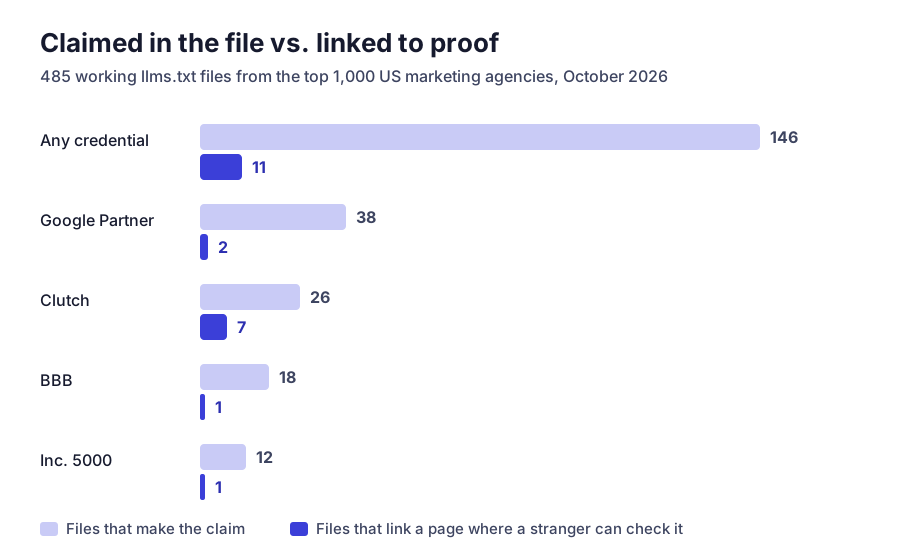
- Of 485 working llms.txt files from the top 1,000 US marketing agencies, 146 claim a credential. Only 11 link a page where anyone can check one.
- 38 files say Google Partner. 2 link the Google Partners listing that proves it.
- Only 85 of the 485 name a real person at the company with a role.
- Google says AI answers need no special file. Trust comes from people and proof on your pages, and llms.txt is how you point to them.
- Add a short who and proof block to your file, then back it with Person schema that names the same person and the same links.
A lot of site owners believe an llms.txt file is the thing that gets a business quoted by ChatGPT, Perplexity or Google's AI answers. Google's own guide to AI features and your website says you don't need new machine readable files or AI text files to show up there. The file doesn't earn the citation. The pages it points to do.
So what makes those pages worth quoting? Google's guide to helpful, reliable content says trust is the most important part of E-E-A-T. It also asks for accurate bylines wherever a reader would expect one. That means a real name, a real role and a way to check both. Most llms.txt files skip all three, and the numbers below show how far.
What 485 Agency llms.txt Files Say About Their People
In October 2026, LLMs.txt Generator pulled /llms.txt from the top 1,000 marketing agencies in the US. 485 of them served a working plain text file. The rest had none, blocked the request or served a web page instead.
Agencies are a fair test. They sell search and AI visibility, so their own files should be the best in any industry. A script then read all 485 files for two things. First, does the file name a real person at the company, with a role like founder, CEO or president? Second, does it make a credential claim, and does it link a page where that claim can be checked?
The script flagged every line where a name sat next to a role. Each flagged line was then read by hand, and lines about clients, guests or podcast hosts were dropped. That left 85 files that name someone who works at the agency. That's fewer than 1 in 5.
Many of those 85 only name a person inside a blog post title or a press link. The name is there, but nothing says who runs the place. Only a small group put the founder in the summary or a Key Facts list, where a model reading the top of the file will see it first.
A Claim With No Proof Link Reads Like Every Other Claim
Credentials showed up more often than names. 146 files mention an award, a certification, a partner badge, a BBB rating or a ranking list. Only 11 of those files link a page outside the agency's own site where a stranger could confirm any of it.
| Claim in the file | Files that make it | Files that link proof |
|---|---|---|
| Any credential, award or badge | 146 | 11 |
| Google Partner | 38 | 2 |
| Clutch | 26 | 7 |
| BBB | 18 | 1 |
| Inc. 5000 | 12 | 1 |
| Says licensed | 11 | 0 |
Think about how a model meets that line. "Google Partner" shows up in 38 of these files alone, and on far more agency pages. Some of those claims are current, some are years out of date and some may never have been true. A model can't tell yours apart from the rest unless the file points to the one page that settles it.
The fix costs nothing. The partner listing, the BBB profile and the license lookup already exist. You only have to link them.
How AI Answers Weigh a Name They Can Check
Google's AI Overviews and AI Mode don't use a separate trust system. Google's AI features guide says the same search best practices apply, and that no special schema is needed. Ahrefs found that 76% of AI Overview citations come from pages already in the top 10 results, according to its E-E-A-T research. So the signals that lift a page in search also lift it into the answer.
Google is clear about what those signals include. Its helpful content guide says E-E-A-T isn't a ranking factor on its own. It also says trust matters most, and it warns against deceptive authorship. A named person who can be checked is the plainest trust signal a page can carry.
Ahrefs notes that assistants like ChatGPT and Perplexity lean on search retrieval and their own checks rather than a named E-E-A-T score. When two pages say the same thing, a page tied to a real, checkable person is easier to stand behind. That's where llms.txt helps. It can't make a model trust you, but it can hand the model the right pages to read first.
The usual advice says to list every badge you have in your llms.txt. That makes the file longer, not more believable. One credential with a proof link beats ten without one.
Write a Who and Proof Block Into Your llms.txt
The llms.txt proposal, published by Jeremy Howard in September 2024, asks for an H1 with your name, a short summary in a quote block, then sections of links. It has no author field. You add one inside the free text under the summary, which the format allows. Keep it to a few lines, and put it near the top so a tool that reads only the start still sees it.
A worked example, with brackets where your real details go.
## Key Facts

- Founded [year] by [Full Name], [role]. About [first name]: https://[yoursite]/about/[name]
- [License or certificate name], number [number]. Check it: [the issuing board's lookup page]
- [Partner program] member. Listing: [the partner directory page for your company]
- Reviews: [your BBB or Google Business Profile link]

## People

- [[Full Name]](https://[yoursite]/about/[name]): [role], [years] years doing [the work], [what they personally handle]
Every line does one job. The name says who. The link says where to read more. The proof link says how to check. Leave out anything you can't link, and never list a person who doesn't do the work.
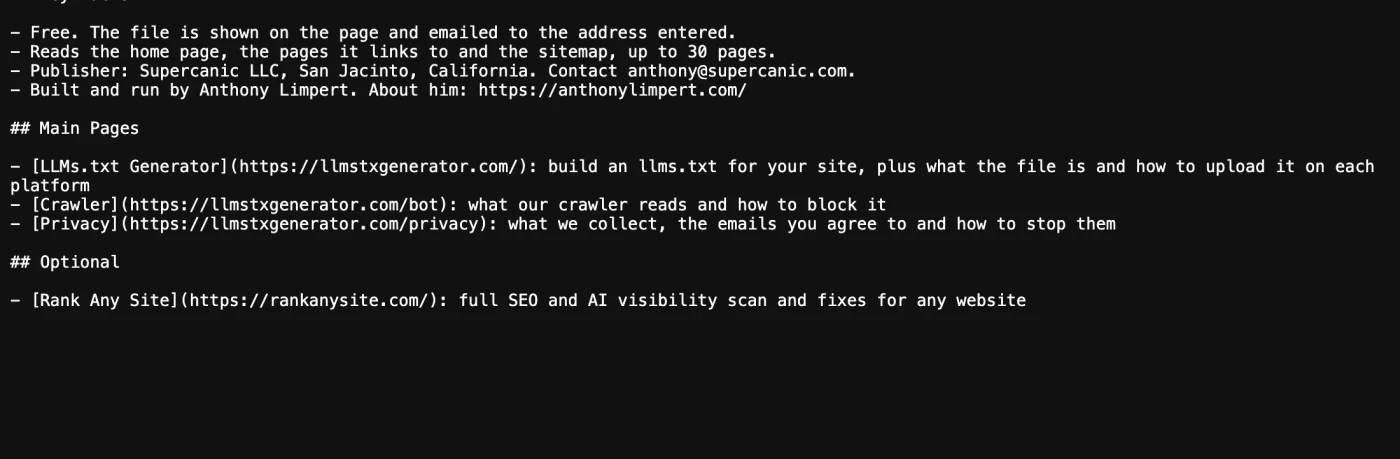
If you don't have a file yet, the free llms.txt generator builds one from your own pages in about 30 seconds. It only uses what is on your site, so add the who and proof lines yourself before you upload it. The upload steps cover WordPress, Shopify, Wix, Squarespace and any other host.
Back It Up With Person Schema and Proof Links
A line in a text file is a claim. The same facts in structured data on the person's page make them easier for a crawler to connect. Google's author markup guide asks for only the name in the author name field. It wants a url or sameAs link to a page that identifies that one person.
Schema.org adds the credential part. The hasCredential property works on a Person or an Organization. Its EducationalOccupationalCredential type has a recognizedBy field for the group that issued it, plus a url and an identifier. That is where the license number and the lookup page go.
{
  "@context": "https://schema.org",
  "@type": "Person",
  "name": "[Full Name]",
  "jobTitle": "[Role]",
  "url": "https://[yoursite]/about/[name]",
  "sameAs": ["[LinkedIn profile]", "[partner directory listing]"],
  "worksFor": {"@type": "Organization", "name": "[Business Name]"},
  "hasCredential": {
    "@type": "EducationalOccupationalCredential",
    "name": "[License or certificate name]",
    "identifier": "[number]",
    "recognizedBy": {"@type": "Organization", "name": "[Issuing board]"},
    "url": "[the board's lookup page]"
  }
}
Keep three things the same everywhere. The name in llms.txt, the byline on your posts and the name in this markup should match letter for letter. Google's AI features guide also says your structured data should match the visible text on the page, so show the credential on the person's page too.
Check What a Crawler Can Find on Your Site
Once the block and the markup are live, test them the way a crawler would. Open yoursite.com/llms.txt in a private window. You should see plain text, your H1 on the first line and the person's name within the first screen. Then open each proof link and make sure it still loads and still says what you claim.
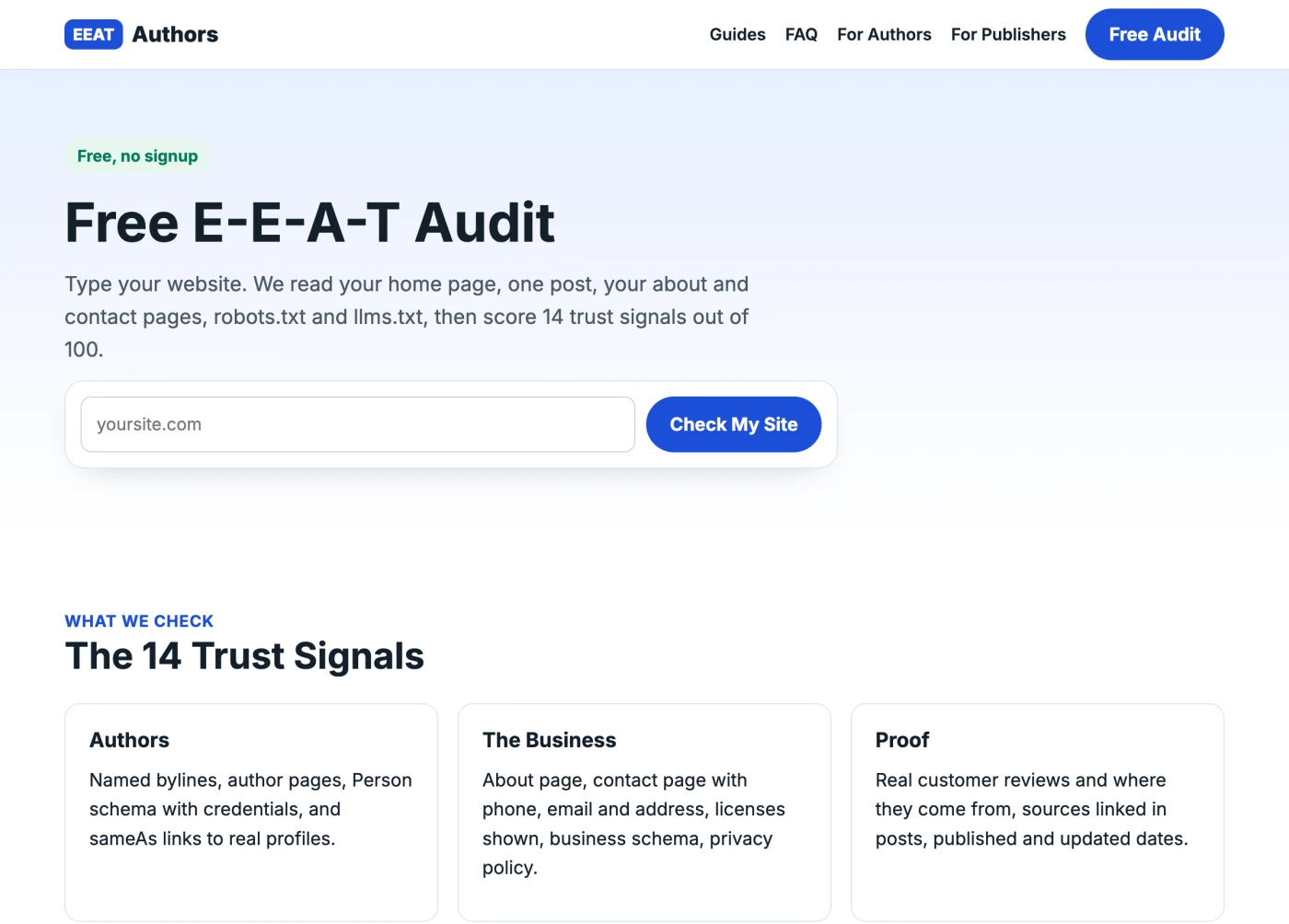
A free tool can do the rest. The free E-E-A-T audit from EEAT Authors reads your home page, one post, your about and contact pages, robots.txt and llms.txt. It scores 14 trust signals out of 100, including named bylines, author pages and Person schema with credentials.
For the rest of your pages, Rank Any Site scans the titles, descriptions, schema and facts AI tools read on every page, free. Fix what both reports flag, then generate a fresh llms.txt so the file matches the site.
No credentials to show yet? That's fine. Name the person who does the work and link proof of real experience. Never borrow a title, invent an expert or list a badge that lapsed. Google calls deceptive authorship a trust problem, and a model that finds one false claim has a reason to doubt the rest.
Things Customers Ask First
- Does an llms.txt file get my business quoted by ChatGPT or Google AI answers?
- Not by itself. Google says you don't need new machine readable files or AI text files to appear in AI Overviews or AI Mode. The file is a short map of your best pages. What gets quoted is the page it points to, and how much a reader or a model can trust it.
- Should my llms.txt name a person?
- Yes, if a real person stands behind the work. Put the full name, the role and one link to a page about that person in your Key Facts. Only 85 of 485 agency files named anyone at the company, so a real name already sets yours apart.
- What counts as a checkable credential?
- One a stranger can confirm on a page you don't control. A state license with the board's lookup page, a partner badge with the partner directory listing, a BBB profile, a degree or certificate with the issuer named. A claim with no link is just text.
- Is E-E-A-T a ranking factor for AI answers?
- Google says E-E-A-T itself isn't a specific ranking factor. It says a mix of signals that point to good E-E-A-T is useful, and that trust matters most. Google says the same search best practices apply to its AI features, so the same trust signals carry over.
- What if nobody on my team has a credential?
- Then don't list one. Name the person who does the work and link the proof of experience they do have, like years in the trade, real project photos or published work. A real expert who agrees to review your pages can add a credential, but never invent a name or a title.
Keep LLMs.txt Generator in your Google results
Research Notes
- Google Search Central, AI features and your website (accessed October 2026)
- Google Search Central, Creating helpful, reliable, people-first content (accessed October 2026)
- Google Search Central, Article structured data (author markup best practices) (accessed October 2026)
- llmstxt.org, The /llms.txt file proposal (accessed October 2026)
- Schema.org, hasCredential property (accessed October 2026)
- Schema.org, EducationalOccupationalCredential type (accessed October 2026)
- Ahrefs, E-E-A-T and AI visibility (AI Overview citation research) (accessed October 2026)
- LLMs.txt Generator, llms.txt check of the top 1,000 US marketing agencies (485 working files) (accessed October 2026)
LLMs.txt Generator is a free tool from Rank Any Site, made by Supercanic LLC. Build your llms.txt file from your own pages in about 30 seconds.